Dow vs. S&P
Contents
About the Author

Buying a home? Check out our great rates. Terms and conditions apply. Loans subject to credit approval. NMLS #406389
FDIC-Insured - Backed by the full faith and credit of the U.S. Government
BankFind
This bank is insured by the Federal Deposit Insurance Corporation. The FDIC Certificate ID is 8021. Click on the Certificate ID # to confirm this bank's FDIC coverage using the FDIC's BankFind tool.
EDIE
EDIE lets consumers and bankers know, on a per-bank basis, how the insurance rules and limits apply to a depositor's accounts-what's insured and what portion (if any) exceeds coverage limits at that bank. Check your deposit insurance coverage >>



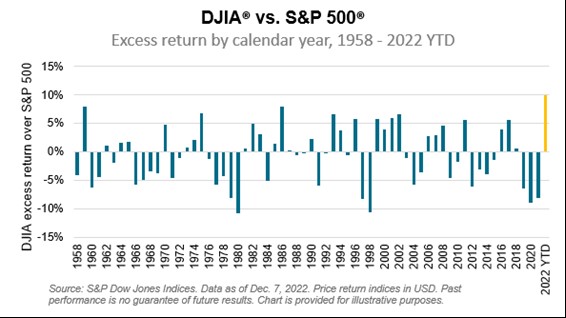
Today’s Chart comes from Benedek Voros from S&P Dow Jones Indices. I always like to point out firsts, and this year there have been many.
The latest one is the Dow Jones Industrial Average, which is comprised of 30 “blue chip” stocks. It is the oldest continuous US stock index dating back to 1896, and it is the most quoted in the news. It leads the S&P 500, arguably the second most popular index, by 10% year-to-date. If this holds up through the end of the year, this will be the largest annual out-performance against the S&P 500 since its inception in 1957.
The Dow Jones index is more concentrated with only 30 stocks, and it is not weighted by the value of the companies. The S&P 500, however, has 500 stocks and is weighted by their size, also known as market cap weighted. This difference provides an opportunity for “dispersion,” which can cause the difference in performance seen this year. Quite simply, this year the Dow just happens to have some stocks that did better than the rest of the market.
Our industry often uses the S&P 500 when quoting “the market” since it more accurately represents all stocks, but we also follow the Dow Jones index since it has such a long history and is often the most quoted in the news.
Now you know the difference.
Experienced professionals from our wealth management services team can help you achieve a bright financial future through investment strategies tailored to you. We’ll show you all of the options available and help you choose the ones best suited to you. We’ll provide high-quality, personal service as we work toward your goals together. Our Portfolio Managers do not receive commissions on trades; our recommendations of investments are based solely on your best interests.
Investments are not a deposit or other obligation of, or guaranteed by, the bank, are not FDIC insured, not insured by any federal government agency, and are subject to investment risks, including possible loss of principal.